
Portugal and Spain on the Cost of Biomethane Connection: Two Models to Address the Same Challenge
The development of biomethane in Europe no longer depends solely on the availability of projects, raw materials, or demand. As the sector matures, the ability to connect plants to gas networks under technically and economically viable conditions is becoming one of the determining factors for accelerating its deployment.
Portugal and Spain are addressing this challenge almost simultaneously, but with different approaches:
- Portugal has just opened a public consultation to develop a mechanism that will allow for the distribution of part of the connection costs for renewable gas producers between the producers themselves and the National Gas System.
-
Spain, for its part, is advancing in the regulation of connections and the necessary infrastructure to increase injection capacity, such as reverse flow systems, but proposes a different model for distributing their financing.
Two approaches worth analyzing because they answer the same question: who should bear the cost of adapting gas networks to incorporate increasing amounts of biomethane?
Portugal Proposes Sharing Connection Costs
The Portuguese Energy Services Regulatory Authority (ERSE) has a public consultation open until September 21, 2026 to modify the regulatory framework applicable to the connection of renewable gas and low-carbon gas producers. The initiative develops Decree-Law No. 94/2026 and addresses not only the economic conditions of connections but also tariffs, network access, operational procedures, and logistical models necessary to facilitate the incorporation of these gases into the Portuguese National Gas System.
One of the most relevant elements of the proposal is the new mechanism for distributing connection costs. ERSE proposes that, for eligible elements:
- 60% of the connection cost be borne by the National Gas System (SNG);
- the remaining 40% correspond to the producer.
The system’s contribution would also have two limits: a maximum of €600,000 per installation and €20,000 per GWh/year of injection capacity. The model starts from a clear idea: if the incorporation of renewable gases adds value to the entire energy system and requires adapting certain infrastructures, a portion of that economic effort can be shared.
Who ultimately finances the system’s share?
Here lies one of the most relevant aspects of the Portuguese proposal. The costs borne by the National Gas System, along with certain costs related to the injection of renewable gases that are not recovered through the specific tariffs applicable to producers, would be incorporated into the access tariffs supported by final consumers. That is, Portugal proposes a partial socialization of the cost of integrating renewable gases into its gas system.
According to ERSE’s estimates, between 2027 and 2031, the planned projects would represent approximately €48 million in connection costs, of which approximately €23 million would be borne by the system. For the period 2031-2040, an additional system contribution of about €11 million is estimated. In total, the projected socialized amount would reach approximately €34 million.
Therefore, it is not about the consumer bearing the full cost of connections. The producer maintains a significant share, and there are limits to the system’s contribution. But Portugal explicitly introduces the principle that part of the cost of incorporating renewable gases can be distributed among all users of the gas system.
Spain is Proposing a Different Model
Spain is also modifying its regulatory framework to facilitate the injection of biomethane and other renewable gases into the networks. The Draft Royal Decree for the Promotion of Biomethane presented by the Ministry for Ecological Transition and the Demographic Challenge incorporates several technical measures aimed at facilitating connection and making better use of existing gas infrastructures. Among these, the regulation of reverse flow equipment stands out, which is essential in certain areas to allow biomethane injected into distribution networks to reach higher pressure networks when local consumption is not sufficient to absorb all production.
The Spanish proposal suggests that this equipment can be integrated as elements of transport or distribution facilities. However, it establishes a regime based on the financing of the investment by the developers of the production facilities, while operation would correspond to the owner of the higher pressure network.
The treatment of connection facilities and direct lines is also clarified. Once commissioned, certain infrastructures can be integrated into the gas system and opened to third-party access.
This introduces a particularly important element: if an infrastructure initially financed by a developer ends up being used by other producers, consumers, or distribution networks, the framework provides for economic reimbursement mechanisms for the initial developer.
Two Models for the Same Question
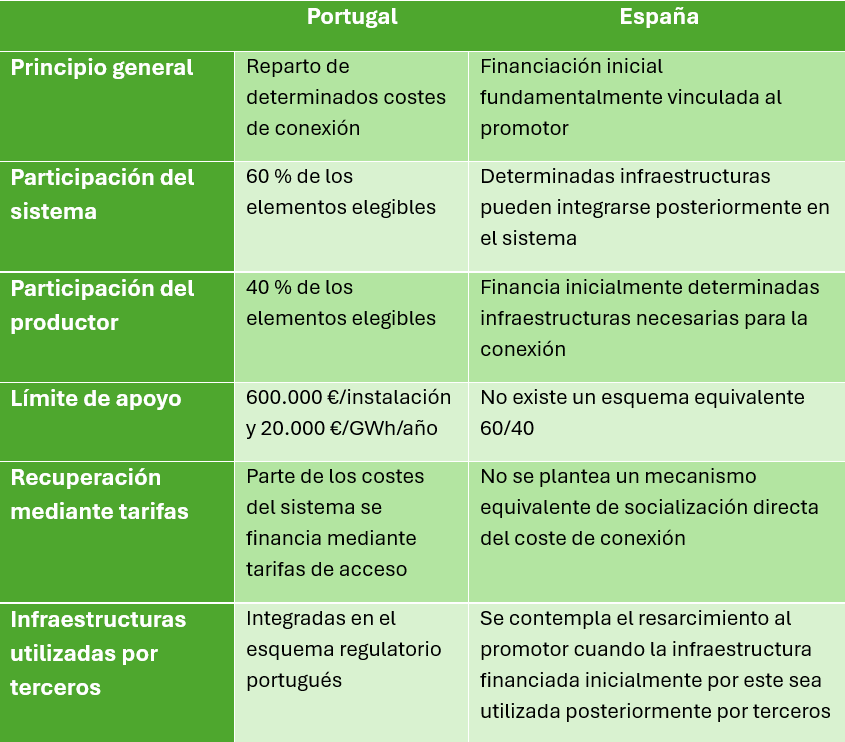
The difference between both approaches can be summarized as follows:
Portugal, therefore, opts to directly reduce the initial investment that the producer must assume, socializing a limited part of the cost.
Spain chooses an approach where the developer retains greater responsibility for initial financing, although certain infrastructures may subsequently be incorporated into the system and used jointly.
The Question Is Not Just Who Pays
At IAM Carbonzero, we consider it positive that biomethane development seeks formulas that minimize the economic impact on the final consumer. But there is another issue that must be addressed simultaneously. If we want to accelerate the deployment of biomethane, connection costs cannot become a barrier that compromises the viability of efficient projects. Especially when an investment initially financed by a producer does not exclusively serve that project, but rather increases network capacity, facilitates new connections, or resolves restrictions that can subsequently benefit other producers.
That is why it is especially important to establish transparent mechanisms that allow distinguishing between the infrastructure exclusively necessary to connect a plant and that which generates a broader benefit for the network and for future users.
A Debate Europe Has Already Opened
This discussion is not exclusively Iberian. Directive (EU) 2024/1788 on the internal markets for renewable gas, natural gas, and hydrogen specifically dedicates Article 58 to the costs and connection fees for biomethane production facilities.
European regulations require Member States to establish a favorable regulatory framework for these connections and expressly state that it must take into account, among other aspects, transparency, non-discrimination, the financial stability of investments, and the advancement of renewable gas deployment. The question that states must now resolve is how to translate these principles into concrete mechanisms: Portugal has put forward an explicit 60/40 split. Spain is building a different model, based on initial financing by developers and the possibility of integrating certain infrastructures into the system, contemplating reimbursement mechanisms when they are utilized by third parties.
The Goal Must Be to Connect More Biomethane at the Lowest Possible Cost
There is not necessarily a single formula. The challenge is to find a balance between three objectives:
- protecting the consumer
- ensuring project viability
- developing a gas infrastructure prepared to incorporate increasing amounts of renewable gases.
At IAM Carbonzero, we believe that Spain has the opportunity to design a model that preserves the first of these principles without compromising the other two. Because not indiscriminately passing on connection costs to all consumers is a reasonable objective. But so is avoiding that infrastructures that ultimately provide capacity and value to the entire system fall exclusively on the first producer who needs to develop them.
Portugal and Spain are seeking different answers to the same problem. The evolution of both models will allow us to verify which mechanisms achieve something that will be decisive in the coming years: converting the potential biomethane production capacity into real network injection capacity.
#Biometano #GasesRenovables #RegulaciónEnergética #TransiciónEnergética #Portugal #España #IAMCarbonzero