Qué hacemos
Nutrients returned to the land
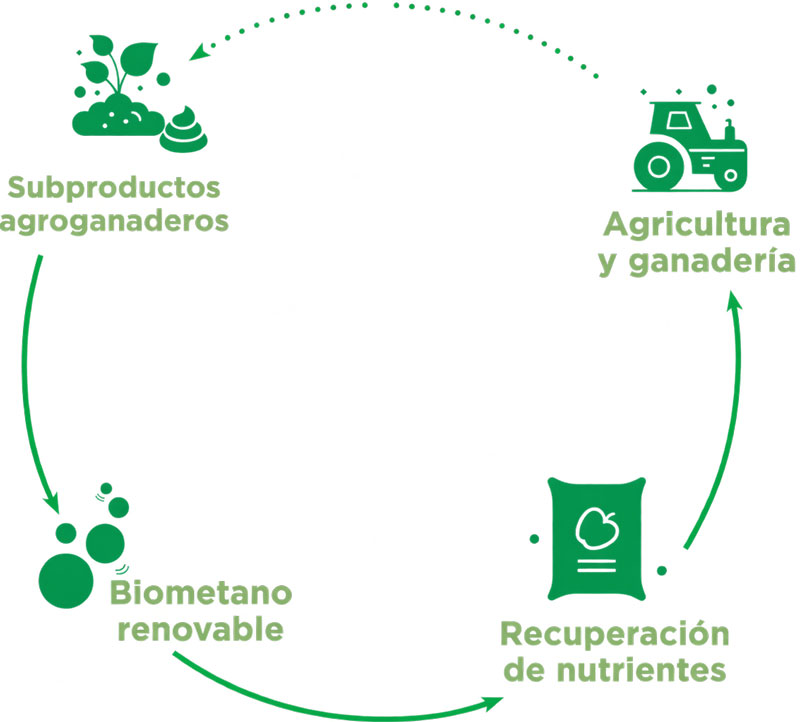
At IAM Carbonzero, we don’t just produce renewable energy. Each biomethane plant returns to agricultural soil the nutrients that came in as a by-product: nitrogen, phosphorus, potassium and organic matter recovered locally, ready for the next crop. Our plants monitor everything that comes in and goes out with full traceability. Our feedstocks do not allow WWTP sludge, Category 1 ABPs, or slaughterhouse waste.
The problem we solve
When producing biomethane, microorganisms break down the organic matter in the by-products, but they don’t consume its nutrients: they concentrate, sanitise and stabilise them. The resulting material—the digestate—contains nitrogen, phosphorus, potassium and organic matter that are more readily available than untreated slurry and manure.
Its agricultural valorisation is not a minor by-product: it’s the part of the cycle that closes the circular economy of each plant. And it solves a real problem for farmers: reducing dependence on mineral fertilisers whose price is dictated by the international gas market.
Critical external dependence:
More than 70% of the nitrogen fertilisers used in Spain come from imports. Every rise in gas prices is passed directly on to farmers’ operating costs.
Soils in decline:
More than 75% of Spanish agricultural soils have organic matter below the sustainability threshold. The trend has been negative for decades.
Regulation that demands solutions:
Traceability and transformation of by-products into a wide range of biofertilisers
The nutrient already exists in the livestock and agricultural by-product:
Nutrient Recovery
Each project is developed taking into account the agronomic characteristics of the territory, the predominant crops, the availability of agricultural and livestock by-products, and the applicable regulatory framework. This is why each plant evolves toward different solutions to recover and valorize nutrients in the most appropriate way.
How we work with you: Tailored solutions
What IAM Carbonzero offers is different: a valorisation process designed for each territory, with prior agronomic analysis, technical support, and full compliance with current regulations. Each plant can develop different products depending on the type of waste processed and the territory’s agronomic needs.

Territorial analysis

We identify the most suitable product
From digestate to fertilizer adapted to each territory
Each plant can develop different products depending on the type of waste processed and the agronomic needs of the territory. The resulting fertilizer format — solid, granulated, pellet, liquid — is decided according to the crop, soil, and regulations of each area.
Our product range includes:
- Liquid organo-mineral fertilizer rich in N
- Organic soil amendment
- Organo-mineral fertilizer
RAW MATERIAL
SOLID DIGESTATE
Solid fraction resulting from the anaerobic digestion process
LIQUID DIGESTATE
Liquid fraction resulting from the digestion process
anaerobic
Certified Transformation
Process Under Regulations
The digestate is transformed into a registered product that farmers can manage without needing to be a waste manager.
Adapted to the Region
The format of the resulting fertilizer depends on the crop, soil, and application system of each area.
Complete Traceability
We document the chain from raw material to final product. Compliance with EU Reg. 2019/1009 and RD 506/2013.
• Framework EU Reg. 2019/1009 and RD 506/2013
• Format adapted to the territory
• Guaranteed composition
• Can be applied directly by the farmer
What We Offer Local Agriculture
— Reduced Fertilization Costs: organic NPK input allows for adjusting and reducing mineral dosage.
— Reduced Dependence on the International Market: locally produced nutrients, without exposure to gas prices or the volatility of mineral fertilizer markets. This reduces price spikes and supply risks during an international crisis.
— Cumulative Fertility: stabilized organic matter improves soil structure, water retention, and microbial activity. Positive effects increase over time.
— Documented Regulatory Compliance: product homogeneity, full traceability, and necessary documentation to comply with current regulations in NVZs, etc.
— Access to Sustainability Seals: the use of locally recovered nutrients contributes to the carbon footprint standards required by today’s agri-food industry.
Discover how you can collaborate with IAM Carbonzero projects and leverage new solutions for your farm
In less than two minutes, we can understand your needs and connect you with the development manager for your area. With IAM Carbonzero you can:
- participate as an investor in a plant project
- provide agricultural and livestock by-products
- access recovered nutrients for your crops